
News, News
DonJoy FullStop vs DonJoy FullForce: Which ACL Brace Is Actually Worth Your Money in 2025?
Nov
DonJoy FullStop vs DonJoy FullForce: Which ACL Brace Is Actually Worth Your Money in 2025?
If you’ve ever priced a high-end knee brace, you know the sticker shock is real. A DonJoy FullStop (soft/sleeve style) runs $200–$350. The rigid DonJoy FullForce? $900–$1,400 depending on custom vs off-the-shelf. So is the rigid brace really 4–5× better, or are you just paying for carbon fiber and bragging rights?
Why DonJoy rigid braces cost so much more
- Aircraft-grade aluminum or carbon-fiber frames
- Custom-molded options and precision hinges
- Patented technologies (FourcePoint hinge + 4-Points-of-Leverage) that no competitor can legally copy yet
- Years of FDA-cleared clinical studies behind every claim
Soft braces like the FullStop are essentially a very sophisticated neoprene sleeve with the same hinge sewn in — dramatically cheaper to manufacture.
The tech they actually share: FourcePoint hinge Both braces use DonJoy’s patented FourcePoint hinge — the only damping hinge with this much published research.
Key findings from peer-reviewed studies:
- Increases knee flexion angle by ~9° at peak posterior ground-reaction force during stop-jumps and cutting (reduces shear on the ACL).[1]
- Significantly lowers peak posterior ground-reaction force itself.[1]
- Reduces ACL strain in the last 25°–30° of extension (the classic “at-risk” zone).[2,3]
- When combined with DonJoy’s 4-Points-of-Leverage frame (rigid braces only), further decreases anterior tibial translation and strain.[4]
- No measurable loss of speed, agility, or vertical jump when wearing it.[1,5]
- Dramatically improves patient confidence and return-to-sport rates after reconstruction.[5]
Bottom line: even the “soft” FullStop delivers evidence-based ACL protection — it’s not marketing fluff.
When the FullStop is enough (and when it isn’t) FullStop wins for:
- Soccer, basketball, running, gym work
- Daily wear / prevention
- Post-op rehab when you’re not cleared for pivoting yet
- Anyone who values slipping it on in 5 seconds and forgetting it’s there
FullForce (or Defiance/Armor) wins for:
- Alpine skiing, wakeboarding, motocross, downhill MTB
- Contact sports with a history of giving-way episodes
- Anyone who has already re-torn once (like me) and never wants to feel that pop again
A rigid frame physically cannot hyperextend past 0–5°. A sleeve, no matter how good the hinge, still allows some frame flex under extreme loads.
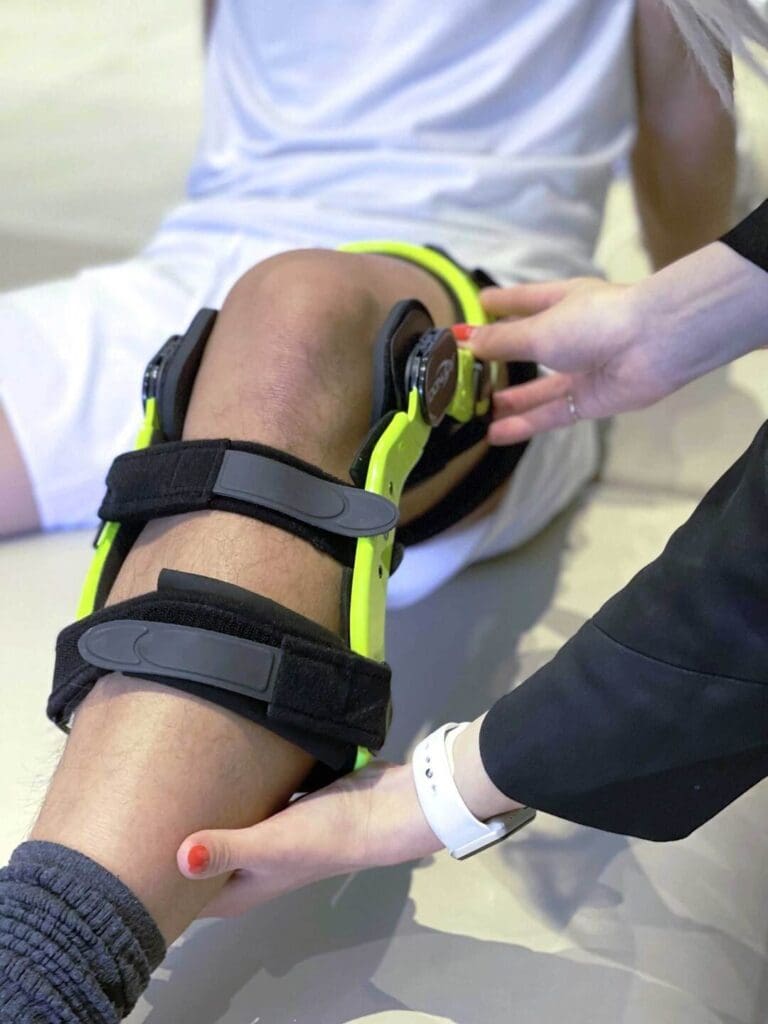
Real-world wearing experience FullStop ? feels like a thick compression sleeve with straps. Washable, zero chafing, can wear under jeans. FullForce ? feels like strapping on Iron Man’s knee. Takes 60–90 seconds to get perfect every time, bulky under pants.
My current rule of thumb in 2025
- Moderate-risk lifestyle or sports ? FullStop (or DonJoy Reaction/Web if you want even lighter)
- High-risk sports + previous rupture ? bite the bullet and go rigid
The research shows bracing can cut re-injury odds by up to 3× when combined with proper return-to-sport timing.[6] Not gambling a third surgery to save $1,000.
Whichever you choose, get properly fitted (custom if budget allows). The brace is insurance — not a superpower.
References [1] JBJS 2010 – Effects of FourcePoint on kinetics & kinematics [2] AJSM 2008 – Reduction of ACL strain with 4-Points-of-Leverage [3] Clin Biomech 2011 – Damping mechanism validation [4] DJO Global clinical summary data [5] Knee Surg Sports Traumatol Arthrosc 2014 – Performance & confidence [6] Br J Sports Med 2018 – Meta-analysis on bracing & re-injury risk